
Description

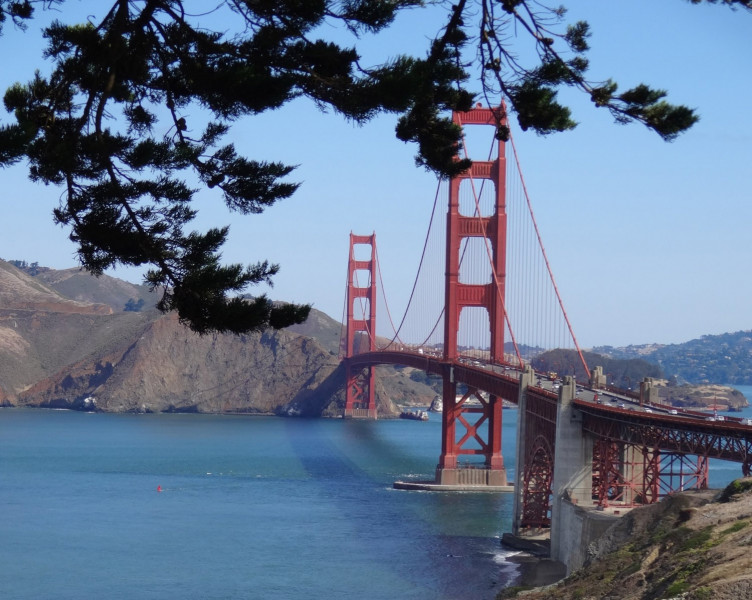
It’s probably the first image that comes to mind when you think of San Francisco: the deep-orange suspension bridge set against the blue ocean and the rocky coastline at the entrance to the city. Of course, you always need a bit of luck to actually see the bridge, since the area around it is also known for heavy fog. So it can indeed happen that you drive from sunny San Francisco into the Bay Area, only to find everything shrouded in thick fog. Nevertheless, around 120,000 visitors cross the approximately 2.7-kilometer-long Golden Gate Bridge every day, and that number grows every year. The bridge connects San Francisco Bay with Napa and Sonoma Valleys—the northern regions of California—and both ends are actually located within the Golden Gate National Parks.
Crossing the Bridge
Why not rent a bike right at the bridge? You can enjoy cycling across it completely free of charge 24 hours a day. To take even better photos from the bridge, just join the crowds of tourists and walk across the bridge in 45–60 minutes. The pedestrian crossings open every day at sunrise and close at sunset. There are even free guided tours every Thursday and Sunday where you can learn about the bridge’s history. Crossing by car is also very easy. If you’re heading north anyway, the crossing is free. On the way back into the city, however, there’s a $6 toll for a standard-sized car, which can be paid in advance online or at the visitor center.
Immediate Surroundings
The “Bridge Pavilion” visitor center offers a wealth of background information and shares interesting stories about San Francisco’s most famous landmark. Of course, you can also pick up a souvenir or two here for those back home or as mementos for yourself. From the Bridge Cafe, you can enjoy a direct view of the bridge while sipping your coffee and savoring American specialties. Pack your camera for a long walk through the Golden Gate National Parks, which guarantee additional panoramic views of the beautiful bridge. The best spots for photos are the Golden Gate and Pacific Overlooks.
Historical Information
In 1846, Captain John C. Fremont named the area the Golden Gate, inspired by a harbor in Istanbul. The first plans to build the bridge were drawn up as early as 1872. Due to strong currents, ever-present fog, and frequent earthquakes, there were serious doubts about whether the project could be realized. But when the ferries reached their capacity limits in the 1920s, the plans were revived.
Construction finally took place under the direction of Josef B. Strauss from 1933 to 1937. Vehicular traffic was first allowed to cross in 1938, and since then, the bridge has never been closed for more than an afternoon. At the time, it was the longest suspension bridge in the world and could only be described in superlatives. Today, at 2,737 meters, it no longer tops the list, but the Golden Gate Bridge was designated one of the modern wonders of the world in 1995.
Interesting facts
- Golden Gate Bridge in San Francisco is among the 3 best rated Tourist Attractions in the USA.
How to get there
By car
Parking spaces are very limited and always subject to a fee. At weekends and on public holidays, the Employee Parking Lot is opened to provide additional spaces. To reach the East Battery car park from San Francisco, follow Highway 101 and then turn onto Lincoln Boulevard. Head a short way down the hill and you will see the car park at the Golden Gate Bridge.
By public transport
MUNI bus number 28 takes you to the famous landmark and back into the city. Bus routes 10, 20, 80 and 101 even let you ride across the bridge from San Francisco.